
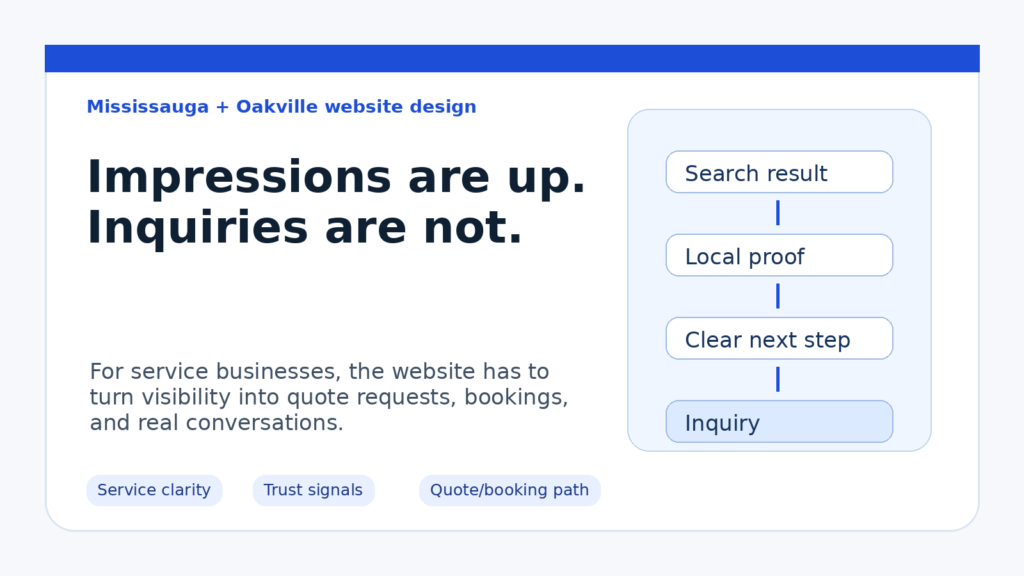
# Why Mississauga and Oakville Service Business Websites Get Impressions but Still No Inquiries
Website design for service businesses is not just about getting a page online. For many local companies in Mississauga, Oakville, and nearby GTA markets, the harder problem is this: the website may start showing in search, but visitors still do not call, request a quote, or book a consultation.
That gap matters. Search impressions can make it feel like marketing is starting to work, but impressions alone do not pay for staff, rent, trucks, tools, software, or follow-up time. A service business website has to help a real person understand the offer, trust the company, and take the next step without confusion.
This is especially important right now for local service pages. If a page is indexed but not getting clicks or inquiries, the next improvement is usually not “write more generic content.” It is making the website clearer, more local, more credible, and easier to act on.
Table of contents
- Website design for service businesses has to connect visibility with action
- Why impressions do not automatically become inquiries
- The local buyer is comparing quickly
- Mississauga and Oakville pages need different local confidence signals
- The inquiry path should be obvious before the visitor is ready to leave
- Proof should sit near the decision, not only on an About page
- Follow-up matters after the form is submitted
- What to fix first
- FAQ
Website design for service businesses has to connect visibility with action
A service business website has a different job from a brochure site. It has to support a buying decision.
Someone searching for a local cleaner, clinic, contractor, accountant, consultant, repair service, or appointment-based business is usually trying to answer practical questions:
- Do they serve my area?
- Do they understand my type of problem?
- Can I trust them enough to contact them?
- What happens after I submit the form?
- Is this company organized, responsive, and real?
Good website design for Mississauga service businesses and web design for Oakville service businesses should make those answers easy to find. If the website only says general things like “professional solutions” or “we help your business grow,” visitors have to work too hard.
That is where inquiries are lost.
Why impressions do not automatically become inquiries
Search impressions mean a page appeared somewhere in search results. They do not mean the result looked convincing, ranked high enough, matched the searcher’s intent, or gave the visitor a reason to act.
A local service website can receive impressions but still fail because of several common issues:
- The page title is too broad and does not sound local enough.
- The meta description talks about services but not the buyer’s problem.
- The page copy is generic and could apply to any city.
- The first screen does not explain who the service is for.
- Contact buttons are present, but the next step is vague.
- There is no proof near the call to action.
- The form feels like a dead end instead of the start of a clear process.
This is why a website can be technically visible but commercially weak. Google may have found it, but the customer has not been given enough reason to choose it.
Google’s own guidance around creating helpful, reliable content is a useful reminder here: pages should be built for real people first, not just for search engines. The same principle applies to conversion. A visitor needs clarity before they take action. See Google Search Central’s guidance on helpful content for the broader search-quality direction.
The local buyer is comparing quickly
Most local buyers do not study one website slowly. They compare several options quickly.
That comparison can be harsh. If one business explains the service area, process, proof, and next step clearly, while another only has a generic homepage and a contact form, the clearer website usually feels safer.
For a service business, “safe” does not mean fancy. It means the visitor can quickly tell:
- what you do;
- who you help;
- where you work;
- what kind of result you support;
- what happens after they contact you;
- whether the business looks active and credible.
This is why local website trust signals matter. They are not decoration. They reduce hesitation.
Mississauga and Oakville pages need different local confidence signals
A service-area page should not feel like a duplicated template with the city name swapped.
A Mississauga page should speak to Mississauga search intent, local service competition, and the reality of serving a larger, more varied business market. An Oakville page should support Oakville search intent, where buyers may be comparing fewer but more trust-sensitive local options.
That does not mean inventing fake local stories. It means being specific about service fit:
- appointment and quote requests;
- local service-area clarity;
- mobile-friendly inquiry flow;
- proof from relevant projects;
- practical follow-up systems;
- clear links between website design, booking, and lead handling.
For example, a company looking for website design in Mississauga may need a stronger service breakdown and clearer quote path. A company comparing web design in Oakville may need stronger trust, proof, and local credibility signals before contacting.
Both need good design. But the emphasis should match the buyer’s hesitation.
The inquiry path should be obvious before the visitor is ready to leave
A common mistake is treating the contact form as the whole conversion system.
The form is only the final step. The real inquiry path starts earlier:
- The visitor recognizes their problem in the page copy.
- They understand the service.
- They see that the business works in their area.
- They find proof or credibility signals.
- They know what the next step is.
- They feel the form or booking action is worth completing.
If any part of that path is weak, inquiries drop.
This is why website design services should include more than page layout. For service businesses, the structure should guide visitors toward a quote request, appointment request, consultation, or practical first conversation.
If bookings or appointments are part of the sales process, a dedicated booking website design approach can help. If the business needs to manage leads after the form, business integrations and follow-up workflows become part of the conversion system too.
Proof should sit near the decision, not only on an About page
Proof works best when it appears close to the moment of hesitation.
If a visitor is deciding whether to contact a business, they should not have to hunt through the entire site to understand whether the company has relevant experience. A short proof block near the CTA can be enough:
- project type;
- business category;
- problem solved;
- service path supported;
- practical result or workflow improvement, without exaggerated claims.
For example, iCloudMount’s recent public proof assets support this direction:
- WellnessSteps website booking workflow case study — useful for appointment, booking, intake, and workflow credibility.
- Galvin CPA Tax website inquiry workflow case study — useful for professional-service inquiry, quote, and lead-management credibility.
These proof pieces support the service pages because they show how website structure, inquiry handling, and workflow support connect in real projects.
Follow-up matters after the form is submitted
Many service websites focus only on getting the form submitted. That is not enough.
The business still has to respond, qualify the lead, send information, book a time, issue a quote, or track the next step. If the website creates inquiries but the follow-up process is messy, leads still leak.
That is why a strong service business website should consider:
- what fields the form should ask for;
- whether the visitor should book a time directly;
- how the lead is notified internally;
- whether the inquiry should enter a CRM or task list;
- what automatic confirmation the visitor receives;
- how quote requests are tracked.
Design and operations are connected. A clean website with a weak lead process is still leaving money on the table.
What to fix first
If your service business website is getting visibility but few inquiries, start with the highest-impact pieces first.
1. Rewrite the first screen for clarity
The top of the page should clearly explain what service you provide, who it is for, and what area you serve. Do not make visitors scroll just to understand the basics.
2. Strengthen the page title and description
For local pages, the title and meta description should match buyer intent. A vague title may earn impressions, but a stronger local title is more likely to earn clicks.
3. Add decision-focused proof
Use short proof blocks, project examples, service-area clarity, practical process notes, and credible business details. Avoid fake numbers or overpromising.
4. Make the next step specific
“Contact us” is sometimes too vague. Try clearer wording such as:
- Request a website review
- Ask about a quote request flow
- Book a consultation
- Plan a service-area website
- Review your lead path
5. Connect the website to follow-up
If every inquiry just lands in an inbox, leads can be missed. Even a simple lead-management structure can improve response consistency.
The practical takeaway
For Mississauga and Oakville service businesses, the next SEO win is not just more visibility. It is turning the visibility that already exists into qualified inquiries.
That requires stronger website design for service businesses: local clarity, trust signals, proof, an obvious inquiry path, and follow-up that does not depend on memory or luck.
If your website is getting seen but not contacted, iCloudMount can review the page structure, service-area message, CTA path, and lead-handling flow. Start with website design services, or go directly to the relevant local page for Mississauga website design or Oakville web design.
Book a consultation with iCloudMount to review where visitors are dropping off and what should be fixed first.
FAQ
What is website design for service businesses?
Website design for service businesses is the planning, writing, design, and technical setup of a website that helps local customers understand the service, trust the provider, and take action through a quote request, booking, phone call, or consultation form.
Why does my local business website get impressions but no inquiries?
A website can get impressions but no inquiries when the page is visible in search but does not look relevant, trustworthy, local, or easy to act on. The issue is often weak page titles, generic copy, unclear service-area messaging, missing proof, or a confusing contact path.
Should Mississauga and Oakville service pages have different content?
Yes. The core service can be similar, but each page should speak to its local audience, service-area fit, proof, and buyer hesitation. City pages that only swap the location name usually feel weaker to both visitors and search engines.
Do booking forms and CRM integrations affect website conversions?
They can. A better form, booking path, or CRM workflow helps the business respond faster and track leads more reliably. For many service businesses, the conversion problem is not only the website page. It is also what happens after the inquiry arrives.
What should I improve first if my website is not generating leads?
Start with the first screen, service clarity, local trust signals, proof near the CTA, and a clear next step. After that, improve the form or booking process and make sure inquiries are tracked instead of being left in a general inbox.