# Before Running Google Ads: Is Your Local Business Website Ready to Turn Clicks Into Leads?
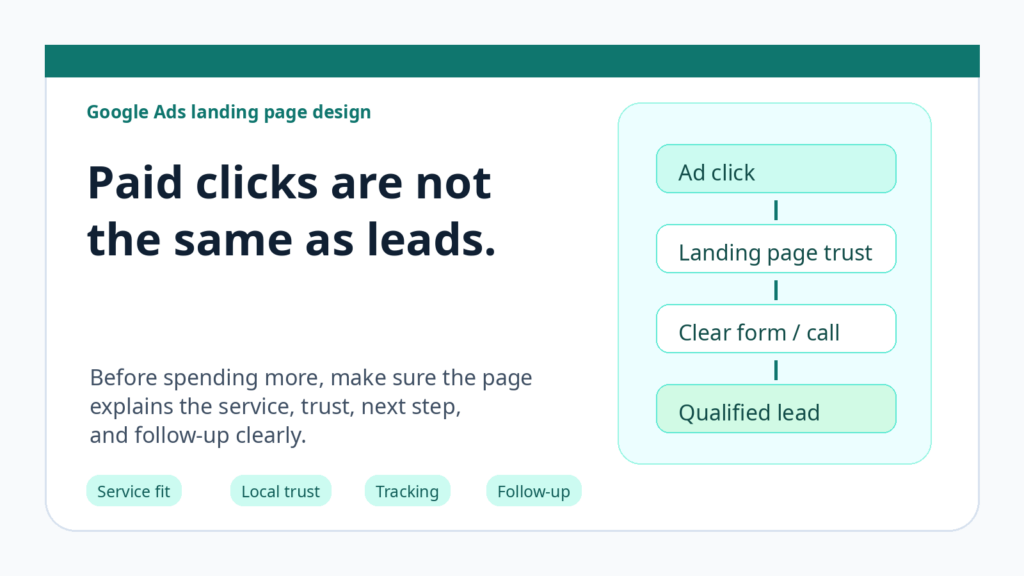
Google Ads landing page design matters because paid traffic does not fix a weak website. For local businesses in Oakville, Mississauga, Milton, Burlington and the GTA, ads can put the business in front of buyers quickly — but the page still has to convince those buyers to call, request a quote, book a consultation, or send project details.
This is the part many businesses underestimate. Google Ads can help answer one question: “Can we get in front of people searching for this service?” It does not automatically answer the harder question: “Does our website turn those clicks into qualified leads?”
For iCloudMount, this topic supports the current website-design SEO recovery work while also creating a practical bridge to paid search testing. If organic rankings are slow, a small Google Ads test can be useful — but only if the landing page, tracking, contact path and follow-up process are ready first.
Table of contents
- Google Ads landing page design starts before the campaign
- Why paying for clicks does not guarantee leads
- A paid-search visitor makes a fast comparison
- What a local landing page needs before ads
- The form, phone and booking path need to be obvious
- Tracking matters because guesses get expensive
- When Google Ads makes sense for a local business
- What to fix before spending more
- FAQ
Google Ads landing page design starts before the campaign
A Google Ads campaign should not start with only keywords and budget. It should start with the page people will land on after the click.
A good local landing page should make several things clear quickly:
- what service is being offered;
- which city or area the business serves;
- who the service is best for;
- what problem the business solves;
- why the visitor should trust the business;
- what action the visitor should take next;
- what happens after they submit the form, call, or book.
That is why website design services and paid traffic should not be treated as separate problems. Ads create attention. The website has to convert that attention into a useful business conversation.
Why paying for clicks does not guarantee leads
Google Ads can feel attractive when SEO is moving slowly. That is understandable. Organic ranking takes time, and local service businesses often need inquiries sooner.
But paid clicks can fail for the same reasons organic visitors fail:
- The headline is too general.
- The page does not match the search intent.
- The service area is unclear.
- The visitor cannot tell whether the business handles their type of request.
- Proof and trust signals are missing near the call-to-action.
- The form asks too much too early.
- The business has no clear follow-up process after the inquiry.
- Calls and form submissions are not tracked properly.
If these problems exist, increasing the ad budget may only increase wasted traffic.
The better approach is to use ads carefully: test the market, measure response, and improve the page based on real behaviour.
A paid-search visitor makes a fast comparison
Someone who clicks a Google ad is often comparing options. They may open two or three providers, scan each page quickly, and choose the one that feels easiest and safest to contact.
That comparison is practical, not emotional. The visitor may ask:
- Is this business actually local to my area?
- Do they understand my type of project?
- Can I see what they do without reading too much?
- Is there enough proof or context to trust them?
- Is the next step simple?
- Will someone follow up properly?
For example, a buyer searching for web design in Oakville or Mississauga may not contact the prettiest page. They may contact the page that explains the service clearly, shows practical trust signals, and makes the next step feel low-risk.
That is why local pages such as website design in Oakville and website design in Mississauga need to do more than include city names. They need to help real buyers choose.
What a local landing page needs before ads
Before sending paid traffic to a page, check whether it has the basics needed to convert.
Clear service match
The page should match the ad and the search. If the ad says “booking website design,” the page should not send people to a generic homepage. If the ad targets quote-request websites, the page should talk about quotes, forms, project details and follow-up.
Local relevance
City and service-area details should be natural and useful. A page can mention Oakville, Mississauga, Milton, Burlington or GTA service areas, but it should also explain what kind of local business need the page supports.
Trust near the action
Trust should not be hidden at the bottom. The page should include practical signals near the form or button: project examples, service process, contact details, support expectations, local context, or links to relevant proof.
For more on this, see local website trust signals.
One clear next step
A landing page should not make visitors guess. Depending on the service, the CTA may be:
- request a website review;
- book a consultation;
- ask for a quote;
- send project details;
- call for a quick fit check.
The wording should tell the visitor what they are getting, not only say “Contact Us.”
The form, phone and booking path need to be obvious
A paid-click visitor should not have to hunt for the next step.
For many local businesses, the page should include both a short form and a clear contact option. Appointment-based businesses may also need a booking path. Quote-based businesses may need fields that help qualify the request without making the form too heavy.
This is where booking website design becomes relevant. The goal is not only to collect a click. The goal is to create a path from interest to inquiry, appointment, quote request, or consultation.
A strong lead path usually answers:
- What should the visitor do now?
- How long will it take?
- What information is needed?
- What happens after submission?
- Will someone call, email, or schedule a meeting?
When that is unclear, visitors often leave — even if the ad brought the right person.
Tracking matters because guesses get expensive
If a business runs Google Ads without tracking, it is difficult to know what is working.
At minimum, the business should be able to separate:
- ad clicks;
- landing page visits;
- form submissions;
- phone clicks;
- booking clicks;
- qualified leads;
- poor-fit inquiries.
Google’s own documentation on conversion tracking is worth understanding before spending seriously. Without conversion tracking, a campaign may look busy while producing little useful revenue.
For a local service business, tracking does not have to be complicated at the start. But the basic path from campaign → landing page → inquiry → follow-up should be visible.
When Google Ads makes sense for a local business
Google Ads can make sense when a business needs faster market feedback than SEO can provide.
It may be useful when:
- the service has clear commercial search intent;
- the city or service area is specific;
- the offer is easy to understand;
- the landing page is strong enough to convert;
- phone/form tracking is in place;
- the business can respond quickly to leads;
- there is a plan to improve the page based on results.
For example, a small test around website design, booking website design, or e-commerce website design in specific GTA cities can help reveal which keywords and offers create real inquiries.
But ads should not be treated as a substitute for a weak website. They are a way to test demand and accelerate feedback. The website still has to do the conversion work.
What to fix before spending more
Before increasing a Google Ads budget, fix the page elements closest to conversion.
1. Match the page to one clear service
Do not send every ad to the homepage. Use a page that matches the search intent and service offer.
2. Strengthen the first screen
The first screen should explain the service, area, audience and next step without forcing the visitor to scroll too much.
3. Put proof close to the CTA
Add trust signals, process details or relevant examples near the form or button.
4. Make the inquiry path specific
Use CTA wording that tells the visitor what they are requesting. “Request a website review” is stronger than a vague “Submit.”
5. Track the result
Make sure form submissions, phone clicks and booking clicks can be measured. Otherwise, the campaign will be hard to judge.
6. Connect follow-up
If inquiries go into email and get forgotten, the campaign will underperform. Simple business integrations and workflow automation can help organize lead follow-up, notifications and customer records.
A practical way to test without wasting budget
A local business does not need to start with a large ad budget.
A more controlled test could look like this:
- Pick one service and one city cluster.
- Build or refine one strong landing page.
- Use a small budget for two to three weeks.
- Track form submissions, calls and booking actions.
- Review search terms and inquiry quality.
- Improve the page before scaling spend.
This approach keeps Google Ads useful without pretending paid traffic is magic.
SEO still matters. But while SEO builds slowly, a controlled ads test can provide faster feedback about which service, city and message actually creates buyer response.
FAQ
What is Google Ads landing page design?
Google Ads landing page design is the process of building or improving the page that paid-search visitors reach after clicking an ad. For local businesses, it should match the searched service, show local relevance, build trust quickly, and make the inquiry path clear.
Should I run Google Ads if my SEO is not working yet?
You can, but only carefully. Google Ads may help test demand faster than SEO, but it will not fix a weak page. Before spending seriously, make sure the landing page, CTA, tracking and follow-up process are ready.
Is the homepage good enough for Google Ads?
Sometimes, but often no. A homepage usually tries to explain the whole business. A stronger ad landing page focuses on one service, one type of buyer, and one next step.
What should a local service business track from Google Ads?
At minimum, track ad clicks, landing page visits, form submissions, phone clicks, booking clicks and lead quality. Without that, it is hard to know whether the campaign is producing real business value.
Can iCloudMount help prepare a landing page before ads?
Yes. iCloudMount can review or build the website page, contact path, booking or quote flow, and basic tracking structure so paid traffic has a better chance of turning into useful inquiries.
Before you spend more on ads, check the page first
Google Ads can bring faster traffic than SEO, but the landing page still decides whether that traffic becomes a lead.
If your local business is considering paid search, iCloudMount can help review the service page, CTA, inquiry path, tracking setup and follow-up workflow before you spend more budget.
Contact iCloudMount to review whether your website is ready to turn paid clicks into qualified leads.