# Why Service Businesses in Mississauga and Oakville Lose Quote Requests on Their Website
Quote request website design is one of the most overlooked parts of a local service website. Many service businesses in Mississauga, Oakville, and nearby GTA markets explain what they do, but the website still does not make it easy enough for a serious visitor to ask for a quote, book a first conversation, or send useful project details.
That is a quiet conversion problem. The website may look professional. The service list may be accurate. The contact page may technically work. But if the visitor is unsure what to ask, what information to send, what happens next, or whether the business is a good fit, the quote request never happens.
For local service businesses, this matters because search visibility is only the start. A page that earns impressions but fails to create quote requests is not carrying its commercial weight.
Table of contents
- Quote request website design starts before the form
- A service list is not the same as a buying path
- Where local quote requests usually break
- Mississauga and Oakville buyers need local confidence
- The quote path should answer practical questions
- Proof should support the quote decision
- Booking, forms, and follow-up are part of the website
- What to improve first
- FAQ
Quote request website design starts before the form
A quote request does not begin when someone reaches the form. It begins when the visitor first decides whether the business feels relevant, credible, and worth contacting.
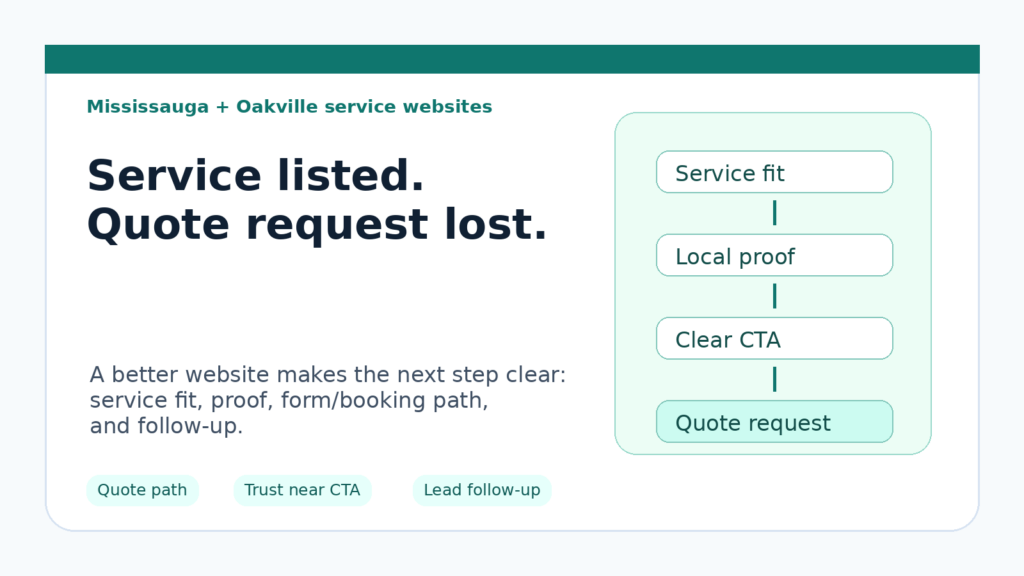
Good quote request website design connects several pieces:
- a clear service promise;
- a location or service-area match;
- practical explanation of who the service is for;
- visible proof or trust signals;
- a specific next step;
- a form or booking path that feels useful, not vague.
This is why effective website design services should not stop at layout. For a service business, the page structure has to reduce hesitation and guide the visitor toward action.
A service list is not the same as a buying path
Many websites have a common structure: homepage, services page, about page, contact page. That structure is fine, but it does not automatically create leads.
A visitor looking for help with a renovation, cleaning service, accounting support, clinic appointment, repair service, consulting project, or local professional service is usually thinking through practical concerns:
- Is this service actually for my situation?
- Do they work in my area?
- Can they handle the type of request I have?
- Do they seem organized and trustworthy?
- What should I send first?
- Will I get a call, a quote, a booking link, or a consultation?
If the website only lists services but does not answer these questions, the visitor may leave and compare another business. The problem is not always traffic. Sometimes the problem is that the page never builds enough confidence to ask for a quote.
Where local quote requests usually break
Quote requests often break at small friction points. None of them seem dramatic on their own, but together they make the visitor hesitate.
Common problems include:
- The first screen says what the company does, but not who it helps.
- The page mentions a city, but gives no local context or service-area clarity.
- The service descriptions are too broad to match a real buyer’s problem.
- The CTA only says “Contact Us” without explaining the next step.
- The form asks for too much, too little, or the wrong information.
- There is no proof near the quote button.
- The visitor cannot tell whether they are requesting a price, booking a call, or starting a project review.
These issues are especially damaging for local service pages. Someone searching for website design in Mississauga or web design in Oakville is usually comparing options quickly. A clearer quote path can be the difference between a visitor and a lead.
Google also keeps emphasizing helpful, people-first content. That principle applies beyond ranking. A website should help the visitor make a decision, not just give search engines text to crawl. Google’s own guide to creating helpful, reliable content is a useful reference point for this mindset.
Mississauga and Oakville buyers need local confidence
Local buyers do not only compare design. They compare trust.
For Mississauga service businesses, a website may need to show that the business can serve a broader, more competitive market with clear service categories, quote details, and response process. For Oakville service businesses, buyers may pay closer attention to credibility, presentation, local fit, and proof before they contact.
That does not mean every city page needs fake local stories or keyword stuffing. It means the website should make local confidence obvious:
- which areas are served;
- which types of clients or projects are a good fit;
- what information helps start the quote;
- what the business does after receiving the request;
- why the visitor should trust this company over another option.
A city page that only swaps the location name usually feels thin. A stronger page gives the buyer enough context to take the next step.
The quote path should answer practical questions
A good quote request path is not just a button. It is a set of answers placed in the right order.
Before asking someone to submit a form, the page should explain:
What kind of quote or first conversation is available
Is the visitor asking for a fixed project quote, a consultation, an estimate, a service review, or a booking time? If the next step is vague, people hesitate.
What information the business needs
For a service business, a useful form may ask for location, service type, timeline, current website or project details, and preferred contact method. The form should feel purposeful, not random.
What happens after submission
Even one sentence can help: “After you send the request, we review the details and reply with next steps.” That kind of clarity lowers uncertainty.
Whether booking is better than a general form
Some businesses should offer a quote request form. Others should offer direct appointment booking or consultation scheduling. If the sales process depends on appointments, booking website design may be the better path.
Proof should support the quote decision
Proof should appear close to the decision point, not hidden only on a separate About page.
For quote requests, useful proof can include:
- a short project example;
- a relevant business category;
- a case study link;
- a clear process note;
- practical service details;
- local trust signals;
- examples of how inquiries, bookings, or workflows are handled.
For example, iCloudMount’s public proof assets support this direction:
- WellnessSteps website booking workflow case study shows how website, booking, intake, payment, invoice, and workflow pieces can support an appointment-based business.
- Galvin CPA Tax website inquiry workflow case study shows how website, inquiry, quote, and lead-management support can help a professional-service business handle online leads more clearly.
These are not decorative links. They help show that website design, quote requests, booking, and follow-up are connected.
If a business does not yet have public case studies, it can still use local website trust signals such as service-area clarity, process detail, real project descriptions, credentials, photos, and clear business information.
Booking, forms, and follow-up are part of the website
A quote request is only valuable if the business can handle it.
That means the website should connect with the real follow-up process. Depending on the business, that may include:
- email notifications;
- CRM or spreadsheet tracking;
- automatic confirmation messages;
- appointment scheduling;
- internal tasks;
- quote status tracking;
- reminders for unanswered leads.
This is where business integrations and workflow automation become important. If leads arrive but get buried in an inbox, the website is still leaking opportunities.
A better quote request path should make life easier for both sides: the visitor knows what to do, and the business knows how to respond.
What to improve first
If a local service website is visible but quote requests are weak, start with the parts closest to the buying decision.
1. Make the first screen specific
Say what service is offered, who it is for, and what area is served. Avoid vague phrases that could belong to any company.
2. Replace generic CTAs with clearer next steps
Instead of only using “Contact Us,” test more specific wording:
- Request a website review
- Ask about a quote request flow
- Book a consultation
- Plan a service-area page
- Send project details
3. Put proof near the CTA
Add a short proof block, case-study link, process note, or local trust signal before the quote request section.
4. Ask for the right information
A good form should collect enough detail to qualify the request without making the visitor feel like they are doing paperwork.
5. Connect the form to follow-up
If every quote request lands in a general inbox with no tracking, leads can be missed. Even a simple follow-up workflow can improve consistency.
The practical takeaway
For Mississauga and Oakville service businesses, more search visibility is useful only if the website turns that attention into real conversations.
Strong quote request website design makes the next step clear. It explains the service, supports local trust, shows proof near the decision, asks for the right details, and connects the inquiry to follow-up.
If your website is being seen but not producing enough quote requests, iCloudMount can review the page structure, CTA path, form, booking flow, and lead-handling process. Start with website design services, or review the local service pages for Mississauga website design and Oakville web design.
Book a consultation with iCloudMount to review where the quote request path is breaking and what should be fixed first.
FAQ
What is quote request website design?
Quote request website design is the planning, copy, layout, form, CTA, and follow-up path that helps a website visitor confidently request pricing, send project details, book a consultation, or start a service conversation.
Why do people visit my service website but not request a quote?
People may visit but not request a quote if the service is unclear, the page does not feel local or trustworthy, proof is missing, the CTA is vague, or the form does not explain what happens next.
Should a service business use a quote form or online booking?
It depends on the sales process. If the business needs details before pricing, a quote request form may work better. If the first step is a call, appointment, assessment, or consultation, online booking may reduce friction.
How can Mississauga and Oakville service websites improve quote requests?
They can improve quote requests by making local service fit clear, placing proof near the CTA, explaining the next step, using a practical form, and connecting inquiries to a reliable follow-up workflow.
Does better quote request website design help SEO?
It can support SEO indirectly by making the page more useful, specific, and aligned with buyer intent. The direct goal is stronger conversion: turning qualified search visitors into quote requests, bookings, or consultations.