
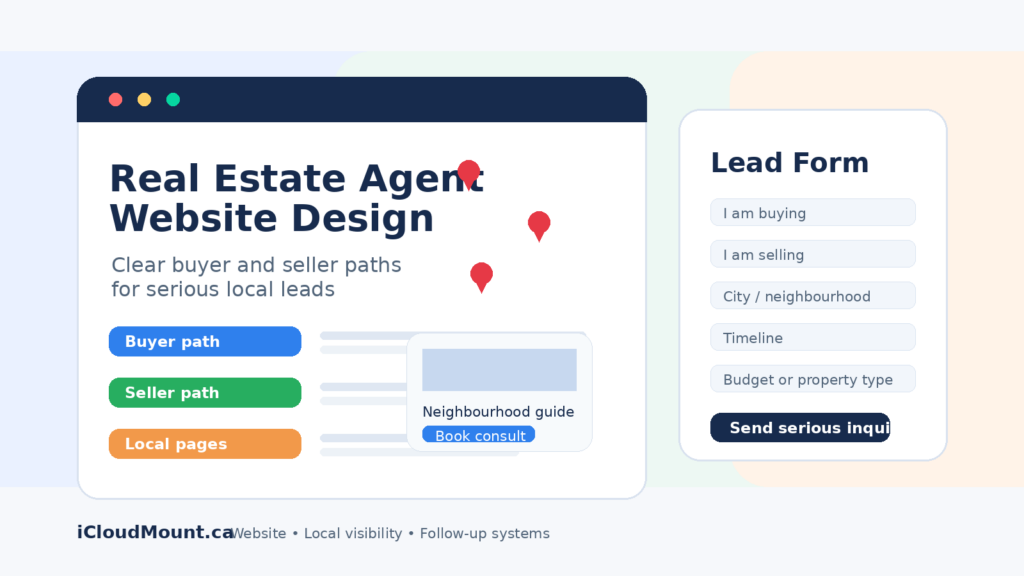
Real estate agent website design should do more than show a headshot, a slogan, and a generic contact form. For agents and small teams in Mississauga, Oakville, Milton, Burlington, and the GTA, the website needs to help buyers, sellers, landlords, tenants, and investors understand why they should contact you — and what happens next.
For agents and local businesses targeting buyers, sellers, and service clients in the city, this also connects with our dedicated website design Mississauga landing page.
A real estate website does not replace referrals, networking, portal exposure, or social content. But it can make those channels work harder. When someone hears your name, clicks from Google Business Profile, sees your listing post, or searches for a local agent, the website should quickly answer practical questions and make the next step easy.
Too many agent websites look polished but feel interchangeable. They say “trusted,” “experienced,” and “local expert,” but they do not explain service areas, buyer process, seller process, property types, neighbourhood knowledge, or how a lead should start. That makes visitors hesitate — especially when they are comparing several agents at once.
If your real estate website is meant to generate better inquiries, the structure matters.
Table of contents
- Why real estate agent website design matters
- Start with buyer and seller intent
- Build stronger local landing pages
- Make listings useful without depending only on IDX
- Show trust proof clearly
- Design lead forms around real estate conversations
- Connect the website to follow-up workflows
- FAQ
- Final takeaway
Why real estate agent website design matters
Real estate agent website design matters because buyers and sellers are often making a high-trust decision before they ever contact you. A homeowner may be deciding who to invite for a listing conversation. A buyer may be checking whether you actually understand their target area. An investor may want to see whether you can speak clearly about rental demand, numbers, or property type.
A good website helps visitors answer:
- Do you work in the city or neighbourhood they care about?
- Do you mainly help buyers, sellers, investors, renters, or a mix?
- Do you understand condos, detached homes, townhouses, pre-construction, leases, or commercial property?
- What does the first conversation look like?
- Can they see proof, reviews, useful guidance, or local knowledge?
- Is there a simple way to ask a serious question?
For local real estate professionals, a strong website is not just a brochure. It is a trust filter, lead-capture tool, local visibility asset, and follow-up starting point.
That is why a real estate website should be planned as part of a broader small business website design and local conversion system — not just as a theme with listing widgets added afterward.
Start with buyer and seller intent
Buyers and sellers do not visit a real estate website with the same mindset.
A buyer may want listings, neighbourhood information, school-area context, commute notes, property-type guidance, mortgage readiness reminders, or help understanding the offer process. A seller may want pricing confidence, market preparation advice, staging guidance, recent comparable sales, marketing process, and a clear next step for a home evaluation.
If both audiences are pushed into one vague “Contact me today” page, the website loses useful intent.
A practical real estate website should separate the major paths:
- Buying a home
- Selling a home
- Condo buying or selling
- First-time buyer guidance
- Investment property support
- Leasing or rental help, if offered
- Relocation support, if relevant
- Neighbourhood or city-specific pages
Each path can explain the situation, common questions, process, and next step. This is better for visitors and also gives Google clearer page topics to understand. For many local service businesses, stronger visibility begins with service-page clarity, which is the same principle behind iCloudMount’s local website visibility support.
Build stronger local landing pages
A GTA real estate website should not rely only on one homepage to rank, convert, and explain everything.
If you serve Mississauga, Oakville, Milton, Burlington, Toronto, Brampton, or other local markets, each important area may deserve its own page — but only if the page is genuinely useful. Thin city pages with copied paragraphs and swapped city names are not enough.
A stronger local real estate page may include:
- The type of clients you help in that area
- Property types you commonly work with
- Neighbourhood or community notes
- Buyer and seller questions specific to that city
- Links to relevant buyer, seller, condo, or investment pages
- A clear CTA for a consultation or property discussion
- Photos, proof, or market commentary when available
The goal is not to create dozens of empty location pages. The goal is to make your local expertise easier to understand.
For example, a page for “selling a condo in Mississauga” should not sound the same as a page for “buying a detached home in Milton.” Different customers have different concerns. Good page structure reflects that.
Google’s own guidance around helpful content emphasizes creating content for people first, not just search engines: https://developers.google.com/search/docs/fundamentals/creating-helpful-content. That matters in real estate, where generic market copy is easy to produce but rarely builds trust.
Make listings useful without depending only on IDX
Many real estate websites add IDX or listing search and assume the website is now useful.
Listing search can help, but it is not a complete strategy. Large portals already dominate listing discovery. Your website needs to explain why a visitor should work with you, not just let them browse properties they can already find elsewhere.
A stronger listings experience may include:
- Featured listings with plain-language context
- Sold or case-study style examples where rules allow
- Property-type guides tied to common questions
- Neighbourhood pages that explain fit, not just inventory
- Buyer resources that explain what happens after someone finds a listing
- Seller resources that explain how you prepare and market a property
If IDX is used, it should support the user journey rather than bury the website under a generic search interface. The best real estate websites combine listing access with education, trust proof, and clear next steps.
Show trust proof clearly
Real estate is a relationship business, but the website still has to earn confidence quickly.
Trust proof can include:
- Client reviews and testimonials
- Awards or credentials, used honestly and without overdoing it
- Local market experience
- Recently served areas or property types
- Professional photography or listing marketing examples
- Clear explanation of process
- Team introduction and contact details
- Helpful articles answering real client questions
The mistake is hiding proof in random sections or relying only on vague claims. “Top service” means less than a specific example of how you help sellers prepare, how you guide first-time buyers, or how you communicate during a transaction.
A real estate website should make credibility visible without making the page feel like a hard sales pitch.
Design lead forms around real estate conversations
A real estate contact form should collect more than name, email, and message — but it should not feel like a tax return either.
Good form design depends on the inquiry type.
For buyers, useful fields may include:
- Target city or neighbourhood
- Property type
- Budget range
- Timeline
- First-time buyer status
- Mortgage pre-approval status
- Must-have features
For sellers, useful fields may include:
- Property address or city
- Property type
- Selling timeline
- Current condition
- Whether they are also buying
- Preferred consultation time
For investors, useful fields may include:
- Target area
- Property type
- Budget range
- Rental or resale goal
- Timeline
- Current experience level
This information helps the first conversation become more useful. It also reduces back-and-forth, especially if the website connects to a CRM or follow-up workflow through business automation and integrations.
If you offer consultations, calls, or appointment-based discovery, a structured booking path can also help. iCloudMount’s booking website design work is built around this exact problem: turning vague inquiries into clearer scheduled conversations.
Connect the website to follow-up workflows
A real estate website should not treat every lead the same.
A seller asking about a home evaluation may need a different response than a buyer asking about condos near a GO station. An investor lead may need different follow-up than someone asking about a lease. A website can help by sending the right information into the right workflow.
Useful follow-up improvements may include:
- Buyer and seller lead tagging
- CRM routing
- Automated confirmation emails
- Calendar booking links
- Downloadable guide delivery
- Reminder sequences
- Source tracking through GA4 and UTM links
- Form-event tracking for important conversions
This is where the website becomes more than a public-facing page. It becomes part of the operating system for lead handling.
Even simple improvements can help: clearer form fields, better confirmation messages, and a reliable notification flow can prevent leads from slipping through the cracks.
Common real estate website mistakes
Many agent websites struggle because they copy what every other agent is doing.
Common issues include:
- A homepage that says everything but explains nothing
- Buyer and seller content mixed together without clear paths
- Generic city pages with no local usefulness
- Listing search added without a conversion strategy
- Weak contact forms that create vague inquiries
- No strong CTA above the fold
- Reviews hidden too low on the site
- No clear explanation of process
- No useful internal links between services, areas, and guides
- No tracking for form submissions or consultation requests
These are fixable problems. The main point is to design around how real people choose an agent — not just around how a template looks.
What a practical real estate website should include
A strong real estate agent website should usually include:
- A clear homepage with buyer, seller, and local paths
- Dedicated buyer and seller pages
- Local city or neighbourhood pages where there is enough useful content
- Property-type guidance for condos, detached homes, townhouses, or investment properties
- Listing support, if appropriate
- Reviews and trust proof
- A practical consultation or inquiry form
- Clear calls to action throughout the site
- Fast mobile performance
- Basic technical SEO and clean page titles
- Analytics and conversion tracking
For agents in competitive GTA markets, the website has to make the agent easier to understand and easier to contact. That is the real conversion job.
FAQ
What should real estate agent website design include?
Real estate agent website design should include clear buyer and seller paths, local service-area pages, trust proof, property-type guidance, useful listing support, strong calls to action, mobile-friendly design, SEO basics, and inquiry forms that collect the right information for the first conversation.
Does a real estate agent need IDX on their website?
IDX can be useful, but it is not enough by itself. A real estate website also needs local expertise, buyer and seller guidance, testimonials, neighbourhood content, and clear lead-capture paths. Otherwise visitors may browse listings without understanding why they should contact the agent.
How can a real estate website generate better seller leads?
A real estate website can generate better seller leads by explaining the selling process, showing local market knowledge, adding property evaluation CTAs, using seller-specific forms, displaying proof, and making it easy to book a consultation.
How can local SEO help real estate agents?
Local SEO can help real estate agents by making their service areas, property types, and client paths clearer to search engines and visitors. Useful city, neighbourhood, buyer, seller, and property-type pages can support more relevant local visibility over time.
Final takeaway
Real estate agent website design is not about having the flashiest homepage. It is about helping serious buyers and sellers understand your services, trust your process, and take the next step.
If your current website looks fine but does not explain your local value clearly, the problem may not be traffic. It may be structure, messaging, forms, and follow-up.
At iCloudMount, we help local businesses build practical websites that support lead generation, local visibility, booking flows, and business systems. If you want a real estate website that feels clearer and works harder, book a free meeting and we can review what your website needs next.
Related local website design service areas
Real estate agents in the GTA often compete city by city. If you want your website to speak more clearly to local search intent, review our service-area pages for website design in Mississauga, website design in Oakville, website design in Milton, and GTA website design.
Related local website design guides
If you are comparing website structure for another service business, see these related guides:
- Website design for cleaning businesses
- Website design for wellness businesses
- Website services for local businesses