
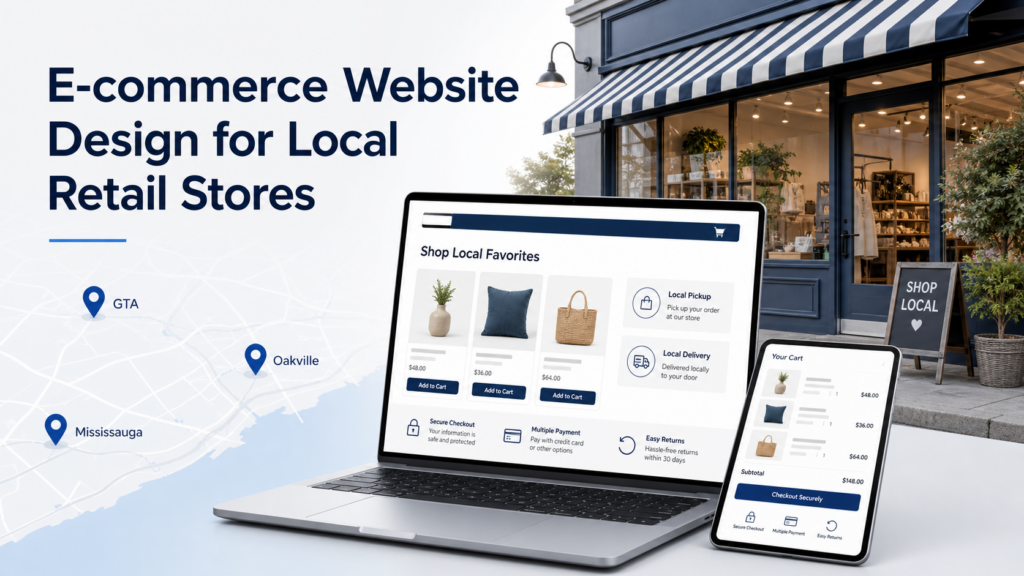
E-commerce website design for local retail stores should help customers understand your products, trust your shop, and buy or inquire without friction. For independent retailers in Mississauga, Oakville, Milton, Burlington, and across the GTA, an online store is not only a digital catalogue. It is a practical sales channel that can support local pickup, delivery, repeat orders, seasonal promotions, and better customer service.
Many small retail websites still sit in an awkward middle ground. The business has good products and loyal customers, but the website is outdated, hard to update, slow on mobile, or missing the buying details people need. Customers may see a few photos on social media, then still have to message, call, or visit in person to ask about price, availability, sizing, pickup, delivery, or payment.
A stronger e-commerce website does not need to feel like a giant marketplace. It needs to make local buying easier, protect trust, and give shoppers a clear next step.
Table of Contents
- [Why E-commerce Website Design for Local Retail Stores Matters](#why-e-commerce-website-design-for-local-retail-stores-matters)
- [What Local Customers Need Before They Buy](#what-local-customers-need-before-they-buy)
- [Product Pages That Reduce Questions and Returns](#product-pages-that-reduce-questions-and-returns)
- [Local Pickup, Delivery, and Shipping Options](#local-pickup-delivery-and-shipping-options)
- [Mobile-Friendly Shopping for Busy Customers](#mobile-friendly-shopping-for-busy-customers)
- [Local SEO for Retail Stores and Product Searches](#local-seo-for-retail-stores-and-product-searches)
- [Inventory, Payments, and Store Operations](#inventory-payments-and-store-operations)
- [Trust Signals That Matter for Small Retailers](#trust-signals-that-matter-for-small-retailers)
- [When a Store Needs Full E-commerce vs. a Simpler Product Catalogue](#when-a-store-needs-full-e-commerce-vs-a-simpler-product-catalogue)
- [Common Local Retail Website Mistakes](#common-local-retail-website-mistakes)
- [A Simple Local Retail E-commerce Checklist](#a-simple-local-retail-e-commerce-checklist)
- [Frequently Asked Questions](#frequently-asked-questions)
Why E-commerce Website Design for Local Retail Stores Matters
E-commerce website design for local retail stores matters because customers now research small shops before visiting, calling, or buying. A customer may discover a store through Google, Instagram, Facebook, a recommendation, a local search, or a product search. Once they land on the website, they want to know whether the product is right, whether the business is real, and whether the buying process is simple.
For a local retailer, the website can support several business goals at once:
- sell products online
- show current product categories
- promote local pickup or delivery
- reduce repetitive questions about price and availability
- support seasonal promotions and gift buying
- collect better inquiries for custom orders
- build trust before someone visits the store
- reduce dependence on marketplace platforms or social media messages
A local retail website should not copy a big-box store. Small shops usually win on product knowledge, curation, personal service, community trust, and convenience. The website should make those strengths easier to see.
If the website only says “visit us” without showing enough product information, many customers will not take the next step. If the online store feels confusing or untrustworthy, they may buy from a larger competitor instead.
What Local Customers Need Before They Buy
Local retail customers are practical. They may like your brand, but they still need answers before they spend money.
Important buying details often include:
- product price
- product size, colour, material, flavour, model, or variation
- current availability or expected restock timing
- pickup and delivery options
- shipping areas and fees
- return or exchange policy
- payment options
- gift card or gift wrapping availability
- store address and hours
- contact method for product questions
- whether the product can be reserved or held
When those details are missing, customers hesitate. They may send a message, but many will simply keep browsing elsewhere.
A good retail e-commerce website reduces uncertainty. It lets the customer quickly decide: “Yes, this is what I need, and I know how to get it.”
Product Pages That Reduce Questions and Returns
Product pages are where many local retail websites either win or lose the sale.
A strong product page should include:
- clear product name
- useful product photos
- price and sale price if applicable
- available variations
- practical description
- sizing or dimensions
- care instructions where relevant
- ingredients or materials where relevant
- pickup, delivery, or shipping notes
- return/exchange expectations
- related products or add-ons
- clear add-to-cart or inquiry button
Photos should be honest and useful. A boutique may need close-ups, full-product shots, scale references, and styling examples. A food or specialty shop may need packaging, portion size, ingredients, and storage notes. A home goods store may need dimensions, material details, colour accuracy, and room context.
Good product descriptions do not need to be long. They need to answer real customer questions. For many small retailers, this is where the website can show the same helpfulness customers get in store.
This connects directly with broader service-page strategy: important products and categories need clear paths, not one vague page for everything. See: https://icloudmount.ca/en/service-pages-small-business-website/
Local Pickup, Delivery, and Shipping Options
Local retailers often have more flexible fulfillment options than large stores, but those options must be clear.
Useful website flows may include:
- buy online and pick up in store
- reserve online and pay in store
- local delivery within selected postal codes
- Canada-wide shipping for selected products
- same-day pickup for in-stock items
- appointment pickup for custom or high-value products
- curbside pickup instructions
The website should explain when orders are ready, how customers will be notified, where pickup happens, and what identification or order number is needed.
For delivery, customers need to know the service area, fees, timing, minimum order value, and any restrictions. A simple postal-code or city-based delivery rule can prevent confusion.
This is where e-commerce design becomes operational. The website should match how the store actually works. A beautiful online shop that creates manual chaos behind the counter is not a good system.
For stores that need product sales, pickup, delivery, and online payments, iCloudMount’s e-commerce website service is the most relevant internal service path: https://icloudmount.ca/en/e-commerce-services/
Mobile-Friendly Shopping for Busy Customers
Many local purchases start on a phone. A customer may be checking a product during lunch, comparing gifts on the couch, looking for a nearby store from the car, or confirming availability before leaving home.
A mobile-friendly retail website should have:
- fast loading product and category pages
- easy product filtering
- readable descriptions and prices
- clear add-to-cart buttons
- simple checkout steps
- tap-to-call contact options
- easy store hours and map access
- visible pickup and delivery information
- minimal form friction
Mobile design is not only about screen size. It is about decision speed. If the customer has to pinch, zoom, wait, or hunt for the checkout button, the sale is at risk.
Small retailers also need to think about social traffic. If someone clicks from Instagram or Facebook, the page they land on should match the product or promotion they saw. Sending every visitor to the homepage creates extra work and loses momentum.
Local SEO for Retail Stores and Product Searches
Local SEO helps nearby customers find your store when they search by product, category, city, or need.
Useful search patterns may include:
- gift shop in Oakville
- specialty food store Mississauga
- baby boutique Burlington
- home decor store Milton
- buy [product] near me
- local pickup [product]
- [product category] store GTA
- custom gift baskets near me
- pet supplies local delivery
The website should support these searches with useful category pages, product pages, local information, and store details. That does not mean stuffing city names into every sentence. It means making the real business, location, products, and service area clear.
Google Business Profile is important, but it cannot replace the website. Your website gives you space to explain products, pickup options, delivery areas, return policies, gift services, and why customers should choose your shop.
For broader visibility planning, see iCloudMount’s SEO services: https://icloudmount.ca/en/seo-services/
For Canadian retail and wholesale context, business owners can also review Statistics Canada’s retail and wholesale statistics: https://www.statcan.gc.ca/en/subjects-start/retail_and_wholesale
Inventory, Payments, and Store Operations
An e-commerce website should support the store’s real workflow.
Before building or rebuilding, a local retailer should clarify:
- how products are added and updated
- who manages photos and descriptions
- whether inventory needs to sync with a point-of-sale system
- which payment methods are accepted
- how taxes are handled
- how pickup orders are prepared
- how delivery or shipping labels are handled
- who receives order notifications
- how refunds, exchanges, and cancellations are managed
Some stores need full inventory synchronization. Others can start with a simpler setup, especially if they sell a limited number of products or use the website mainly for pre-orders and inquiries.
The right answer depends on product volume, staff capacity, POS tools, and how often stock changes.
For stores that need the website to connect with other tools, business integrations may be important: https://icloudmount.ca/en/business-integrations/
Trust Signals That Matter for Small Retailers
Trust is a major part of online retail. Customers may know your store locally, but new visitors still need reassurance.
Useful trust signals include:
- real store photos
- clear address and contact details
- current business hours
- secure checkout
- transparent return and exchange policy
- customer reviews or testimonials
- active product updates
- clear shipping and pickup terms
- helpful FAQ section
- consistent branding between website, social media, and Google Business Profile
For local shops, personality matters too. A short owner note, staff picks, product story, local sourcing information, or behind-the-scenes detail can help the website feel human without becoming cluttered.
The goal is not to look like a national chain. The goal is to look organized, trustworthy, and easy to buy from.
When a Store Needs Full E-commerce vs. a Simpler Product Catalogue
Not every retail business needs a full online checkout on day one.
A full e-commerce store may be a good fit when:
- products are ready to sell online
- prices are clear
- inventory is manageable
- pickup, delivery, or shipping rules are defined
- staff can process online orders
- customers already ask to buy remotely
- the business wants repeat online sales
A simpler product catalogue may be better when:
- products are custom or made to order
- pricing changes often
- inventory is limited or one-of-a-kind
- the store wants inquiries before payment
- staff are not ready to manage online orders
- the main goal is to drive store visits or calls
A catalogue can still be very useful. It can show categories, featured products, custom options, galleries, price ranges, and inquiry buttons. It can later grow into full e-commerce when the workflow is ready.
The mistake is forcing a complex online store before the business can support it. A practical phased build is often smarter.
Common Local Retail Website Mistakes
Common mistakes include:
- only showing product photos on social media, not the website
- hiding prices or availability without a clear reason
- using outdated product categories
- making pickup and delivery rules hard to find
- having no clear return or exchange policy
- sending all campaign traffic to the homepage
- using slow image-heavy pages on mobile
- making checkout too long
- not showing store address and hours clearly
- relying entirely on marketplaces or social platforms
- launching e-commerce without an order-handling workflow
Most of these problems are fixable. The best improvements usually come from watching where real customers hesitate: product detail, trust, delivery, pickup, payment, or contact flow.
A Simple Local Retail E-commerce Checklist
Before rebuilding or improving a retail e-commerce website, check these basics:
- Are product categories easy to understand?
- Do important products have clear photos and descriptions?
- Are prices, options, and availability clear enough?
- Is local pickup explained properly?
- Are delivery or shipping rules easy to find?
- Is the checkout simple on mobile?
- Are store hours, address, phone, and map visible?
- Are return and exchange terms clear?
- Are product pages connected to Google/social campaigns?
- Does the website support local SEO for key product categories?
- Can staff update products without friction?
- Does the order process match real store operations?
If several answers are “no,” the website may be costing sales even if the shop itself is strong.
Frequently Asked Questions
What is e-commerce website design for local retail stores?
E-commerce website design for local retail stores is the planning, structure, design, and setup of an online store or product catalogue for an independent retail business. It usually includes product pages, category pages, checkout or inquiry flow, pickup/delivery options, payment setup, mobile design, local SEO, and trust-building content.
Does every local retail store need online checkout?
No. Some stores need full online checkout, while others need a strong product catalogue with inquiry, reservation, or pickup-request options. The best setup depends on product type, inventory, staffing, delivery rules, and how customers prefer to buy.
What should a local retail e-commerce website include?
A strong local retail e-commerce website should include clear product categories, useful product pages, pricing, pickup or delivery information, store hours, contact details, payment options, return/exchange policies, mobile-friendly checkout, and local SEO content.
Can a small retail website support local pickup?
Yes. Local pickup is often one of the most useful e-commerce features for small retailers. The website can allow customers to order or reserve products online, choose pickup, receive confirmation, and visit the store when the order is ready.
How can a local store improve online sales without becoming too complicated?
Start with the products and workflows that are easiest to manage. A focused product catalogue, clear pickup rules, simple checkout, strong photos, and a few high-value category pages can often perform better than a large but messy online store.
Final Thought
A local retail website should make buying feel easier, not colder. The best e-commerce setup keeps the strengths of a small shop — trust, service, curation, and local convenience — while removing unnecessary friction from the buying process.
If your retail website is outdated, hard to update, or not supporting online sales properly, iCloudMount can help plan a practical e-commerce website that fits your products, customers, and operations.
Start with the e-commerce service page here: https://icloudmount.ca/en/e-commerce-services/
Or book a free assessment: https://icloudmount.ca/book-a-meeting/
Related local website design service areas
Local retailers may need online selling, pickup, delivery, and local visibility working together. We support website design for retailers and service businesses in Mississauga, Oakville, Milton, and across the GTA.