
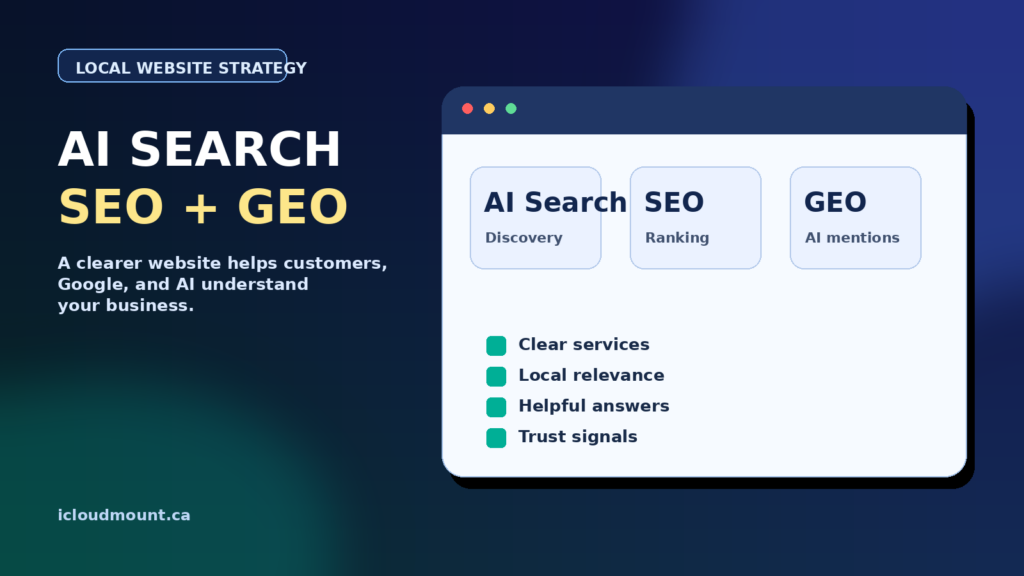
AI search, SEO, and GEO are starting to overlap for local businesses. This AI search SEO GEO guide explains the difference in plain language so business owners can make better website decisions. The terms can sound technical, but the basic idea is simple: your website should help real people, Google, and AI tools understand who you are, what you offer, where you work, and why someone should trust you.
For local service businesses in Mississauga, Oakville, Milton, Burlington, and the wider GTA, this matters because customer discovery is changing. Some customers still use traditional Google search. Some look at map results and reviews. Some may increasingly ask AI tools for recommendations, comparisons, or shortlists.
A good business website now needs to support all of those paths.
It should be easy for people to read. It should be easy for search engines to crawl and rank. It should also be clear enough for AI systems to understand and summarize accurately.
That is where SEO, GEO, and AI search connect.
For teams that need practical local search help alongside clearer website structure, iCloudMount keeps this as secondary support through Website Visibility & SEO Support.
Table of Contents
- [What Is AI Search?](#what-is-ai-search)
- [What Is SEO?](#what-is-seo)
- [What Is GEO?](#what-is-geo)
- [How AI Search, SEO, and GEO Work Together](#how-ai-search-seo-and-geo-work-together)
- [Why This Matters for Local Businesses](#why-this-matters-for-local-businesses)
- [What a Good Website Needs in the AI Search Era](#what-a-good-website-needs-in-the-ai-search-era)
- [Clear Services and Local Relevance](#clear-services-and-local-relevance)
- [Helpful Content That Answers Real Questions](#helpful-content-that-answers-real-questions)
- [Trust Signals AI and Customers Can Understand](#trust-signals-ai-and-customers-can-understand)
- [Structured Pages for Search and AI Understanding](#structured-pages-for-search-and-ai-understanding)
- [Consistent Business Information Across Platforms](#consistent-business-information-across-platforms)
- [Conversion Still Matters After Discovery](#conversion-still-matters-after-discovery)
- [Frequently Asked Questions](#frequently-asked-questions)
What Is AI Search?
AI search is a way of finding information through AI-generated answers, summaries, recommendations, and assistant-style search experiences.
Instead of typing a keyword and reviewing a list of links, a customer may ask a tool a full question, such as:
- “Who offers website design for local service businesses near Oakville?”
- “What should I look for in a website visibility support provider?”
- “Which businesses help service companies improve online bookings?”
- “How do I choose a website developer for a local service business in the GTA?”
The answer may come from a search engine with AI summaries, a chatbot with web access, or another AI-powered recommendation tool.
This does not mean traditional search disappears. But it does mean customers may see fewer options, compare businesses faster, and rely more on summarized information before clicking.
For a local business, the question becomes: when AI search gives an answer, is your business clear and credible enough to be understood, mentioned, or recommended?
What Is SEO?
SEO stands for Search Engine Optimization.
In plain language, SEO helps your website show up better in traditional search results. It includes things like:
- using clear page titles and headings
- writing helpful service pages
- targeting relevant local keywords
- improving website speed and mobile experience
- using internal links between related pages
- earning trust through useful content and reputation signals
- making sure Google can crawl and understand your site
For local businesses, SEO is still important because many customers continue to search on Google before choosing a provider.
If someone searches “website design Oakville local service business” or “website visibility support GTA,” your website needs enough clear, relevant content for search engines to understand that your business may be a good match.
SEO is not just about ranking tricks. Good SEO starts with making your website clear, useful, and relevant.
What Is GEO?
GEO usually means Generative Engine Optimization.
It is the practice of making your business easier for AI-powered search and generative answer systems to understand, trust, and reference.
If SEO is about helping search engines rank your pages, GEO is about helping AI systems understand your business well enough to include it in an answer.
GEO may involve:
- clear explanations of your services
- specific location and service-area information
- helpful FAQ content
- consistent business details across your website and profiles
- case studies, examples, and real-world context
- trustworthy author, company, and contact information
- content that directly answers customer questions
GEO is still an emerging term, and the industry is still learning what works best. But the practical direction is clear: vague, generic, thin websites are harder for AI systems to understand and recommend.
A website with clear service pages, local context, useful answers, and consistent business information is better positioned.
How AI Search, SEO, and GEO Work Together
A simple way to understand the relationship is:
- AI search is the customer behavior.
- SEO helps your website perform in traditional search.
- GEO helps your business become easier for AI systems to understand and mention.
They are connected, not separate.
A business with weak SEO usually has weak GEO foundations too. If Google cannot clearly understand your services, locations, and expertise, AI systems may also struggle to understand them.
A business with strong SEO foundations already has many of the pieces GEO needs:
- clear service pages
- helpful content
- relevant keywords
- crawlable pages
- local information
- trust signals
- structured answers
The difference is that AI search may reward clarity in a slightly different way. It may not only look at whether a page matches a keyword. It may try to understand whether a business is a relevant, credible answer to a real customer question.
That makes the quality and clarity of your website even more important.
Why This Matters for Local Businesses
Local businesses depend on being found at the right moment.
A customer may need a website designer, accountant, contractor, booking system, local SEO service, or custom business tool. They may search on Google, check map listings, read reviews, ask friends, or use AI tools to narrow options.
If your business information is unclear, inconsistent, or too generic, you can lose visibility before the customer ever contacts you.
This is especially important for local service businesses because local search often depends on details:
- What services do you actually provide?
- What cities or regions do you serve?
- Who is your ideal customer?
- What problems do you solve?
- Why should someone trust you?
- What should the visitor do next?
A good website answers those questions clearly.
That helps people. It helps SEO. It helps AI search systems understand you.
What a Good Website Needs in the AI Search Era
A good website in the AI search era is not just a digital brochure.
It should act as a clear source of truth about your business.
That means your website should make it easy to understand:
- your main services
- your service areas
- your ideal customers
- your process
- your proof or trust signals
- your contact or booking path
- your answers to common questions
The goal is not to chase every new AI trend. The goal is to build a stronger website foundation that works across traditional search, AI search, and real customer decision-making.
Clear Services and Local Relevance
Many local service websites are too vague.
They say things like “we provide digital solutions” or “we help businesses grow,” but they do not clearly explain what they do.
That is a problem for customers, search engines, and AI systems.
A better website should have clear service pages for specific offerings, such as:
- website design for local service businesses
- local SEO services
- booking website development
- e-commerce website development
- custom business systems
- CRM and workflow integration
It should also make service areas clear. If you serve Oakville, Mississauga, Milton, Burlington, Toronto, or the wider GTA, say that in a natural and useful way.
Local relevance helps people quickly know whether your business is a fit.
It also gives search and AI systems stronger context.
Helpful Content That Answers Real Questions
Good content is not just content with keywords.
It should answer the questions customers actually ask before they contact you.
For example:
- How much does a local service website need to include?
- Do I need SEO if I already have a website?
- What is the difference between a booking website and a normal website?
- How can a local business get more website traffic?
- What should a service business put on its homepage?
- Will AI search change local SEO?
This type of content helps in three ways.
First, it gives real visitors useful answers.
Second, it helps Google understand your expertise and relevance.
Third, it gives AI systems clearer material to summarize when answering similar questions.
Trust Signals AI and Customers Can Understand
People do not contact a business just because it appears online.
They contact a business when they feel enough trust to take the next step.
Trust signals may include:
- clear company information
- a real address or service area
- contact details
- examples of work
- testimonials or reviews
- industry-specific experience
- helpful educational content
- consistent branding and messaging
- clear explanations of your process
These signals matter for humans. They may also help search and AI systems understand that your business is real, specific, and relevant.
A generic website with very little detail gives everyone less to work with.
Structured Pages for Search and AI Understanding
Website structure matters.
A strong page should have a clear topic, a useful heading structure, and content that flows logically.
For example, a service page should usually explain:
- what the service is
- who it is for
- what problems it solves
- what is included
- why it matters
- where the service is available
- what the next step is
This helps visitors scan the page. It also helps search engines and AI systems understand the page.
A confusing website structure can make good services look unclear.
A clear structure makes the business easier to understand.
Consistent Business Information Across Platforms
Your website is important, but it is not the only source search and AI systems may use.
Your business information should also be consistent across places like:
- Google Business Profile
- social media profiles
- directory listings
- review platforms
- LinkedIn or company pages
- relevant local citations
If your website says one thing, your Google profile says another, and your social profiles are incomplete, it creates confusion.
Consistency helps customers trust you.
It also gives search and AI systems a clearer picture of your business.
Conversion Still Matters After Discovery
Traffic matters first. If nobody finds your business, your website cannot generate leads.
But once people do arrive, the website still has to convert that visit into action.
That is why a good AI-era website needs both visibility and conversion.
It should help people find you, understand you, and contact you.
This means every important page should have a clear next step, such as:
- request a quote
- book a consultation
- call the business
- send a message
- view services
- read a related guide
AI search, SEO, and GEO can help create more opportunities for discovery. But the website still needs to turn the right visitors into real inquiries.
Frequently Asked Questions
What is the difference between AI search and GEO?
AI search is the way users find information through AI-powered answers, summaries, and recommendations. GEO, or Generative Engine Optimization, is the process of making your business easier for AI systems to understand, trust, and mention.
Is GEO replacing SEO?
No. GEO is better understood as an extension of SEO, not a replacement. Strong SEO foundations such as clear pages, helpful content, crawlability, local relevance, and trust signals also support GEO.
Do local businesses still need SEO in the AI search era?
Yes. Local businesses still need SEO because traditional Google search, local search, map results, and website content remain important. AI search adds another layer, but it does not remove the need for strong SEO basics.
How can a local service website support AI search?
A local service website can support AI search by clearly explaining services, locations, customer problems, trust signals, and common questions. The more specific and useful the website is, the easier it is for search engines and AI systems to understand.
What should local businesses improve first?
Start with clarity. Make sure your website clearly explains what you do, who you help, where you work, why customers should trust you, and how someone can contact you. Then build helpful content around real customer questions.
Final Thoughts
AI search may change how people discover local businesses, but it does not remove the need for a strong website.
In fact, it may make website clarity more important.
A good website should support SEO for traditional search, GEO for AI-powered discovery, and real human decision-making after the visitor arrives.
For local businesses in the GTA, the practical goal is simple: build a website that can be found, understood, trusted, and acted on.
If your website is unclear, thin, or hard to navigate, now is a good time to improve it.
If you want a website that supports local SEO, AI search visibility, and better lead generation, iCloudMount can help you build a clearer digital foundation for your business.