
Table of Contents
- [Why Website Design for Landscaping Businesses Matters](#why-website-design-for-landscaping-businesses-matters)
- [Landscaping Leads Are Often Seasonal and Urgent](#landscaping-leads-are-often-seasonal-and-urgent)
- [Service Pages Should Match Real Landscaping Searches](#service-pages-should-match-real-landscaping-searches)
- [Photos Need Context, Not Just Pretty Before-and-After Shots](#photos-need-context-not-just-pretty-before-and-after-shots)
- [Service Area SEO Helps Local Customers Find You](#service-area-seo-helps-local-customers-find-you)
- [Quote Forms Should Ask the Right Outdoor Project Questions](#quote-forms-should-ask-the-right-outdoor-project-questions)
- [Commercial and Residential Landscaping Need Different Paths](#commercial-and-residential-landscaping-need-different-paths)
- [Mobile Design Matters for Homeowners Comparing Contractors](#mobile-design-matters-for-homeowners-comparing-contractors)
- [Common Landscaping Website Mistakes](#common-landscaping-website-mistakes)
- [A Practical Landscaping Website Checklist](#a-practical-landscaping-website-checklist)
- [Frequently Asked Questions](#frequently-asked-questions)
Why Website Design for Landscaping Businesses Matters
Website design for landscaping businesses matters because local customers compare outdoor service providers quickly. They may find your business through Google, Google Business Profile, a referral, a truck on the road, a neighbourhood Facebook group, or a sign at a finished project. But before they contact you, they usually check your website. That website has to answer practical questions:- Do you provide the service I need?
- Do you work in my city or neighbourhood?
- Do you handle residential properties, commercial properties, or both?
- Can I see real examples of your work?
- Do you offer one-time projects, recurring maintenance, or seasonal packages?
- How do I request a quote?
- What information do you need before giving an estimate?
- Are you organized enough to respond clearly?
Landscaping Leads Are Often Seasonal and Urgent
Landscaping demand changes throughout the year. Spring cleanup, lawn repair, garden preparation, planting, sod installation, patio planning, fall cleanup, and snow removal all have timing pressure. That seasonal pattern should shape the website. In spring, customers may search for lawn cleanup, garden beds, mulch, pruning, sod, or general property maintenance. In summer, they may look for landscape design, irrigation, hardscaping, interlock, backyard upgrades, and regular mowing. In fall, they may need cleanup, leaf removal, drainage fixes, and winter preparation. In winter, commercial snow removal and ice management can become urgent. If the website does not make seasonal services visible, the business can miss high-intent searches at the exact moment customers are ready to act. A practical website can support this by:- highlighting current seasonal services on the homepage
- creating service pages for high-value recurring searches
- making quote buttons easy to find
- using Google Business Profile posts to support seasonal offers
- updating photos and service examples throughout the year
- explaining booking windows and expected response times
Service Pages Should Match Real Landscaping Searches
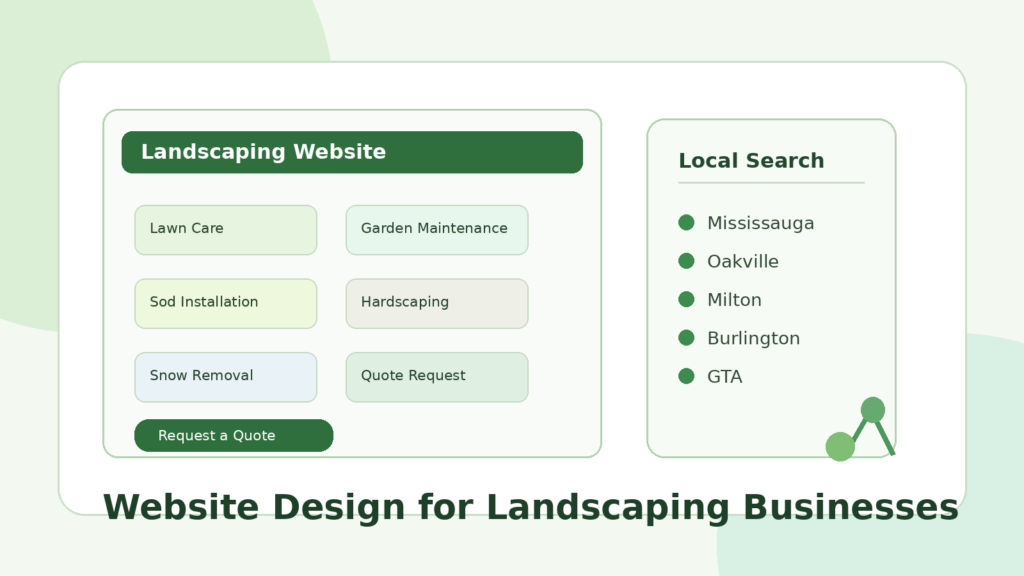
Many landscaping websites have one broad “services” page. That is usually too thin for local SEO and too vague for customers. People often search for specific services, such as:- landscaping company Mississauga
- lawn care Oakville
- spring cleanup Milton
- garden maintenance Burlington
- sod installation GTA
- interlock repair near me
- backyard landscaping Oakville
- commercial snow removal Mississauga
- property maintenance Burlington
- lawn care and mowing
- seasonal property cleanup
- garden maintenance
- landscape design
- planting and garden beds
- sod installation
- interlock and hardscaping
- retaining walls
- drainage and grading
- commercial property maintenance
- snow removal and ice management
Photos Need Context, Not Just Pretty Before-and-After Shots
For landscaping businesses, photos are proof. But photos work harder when they are organized and explained. A useful project photo should include context such as:- service type
- city or service area
- residential or commercial property
- before-and-after comparison
- size or scope of the job
- materials or plants used where relevant
- problem solved
- season of the work
- “Spring cleanup and mulch installation for a residential property in Oakville.”
- “Commercial lawn maintenance and garden bed care for a storefront plaza in Mississauga.”
- “Sod replacement and grading improvement for a backyard in Milton.”
Service Area SEO Helps Local Customers Find You
Landscaping is local. Most companies serve a defined area based on travel time, crew scheduling, job size, and equipment logistics. The website should make that service area clear. Useful service area signals include:- a clear list of cities served
- location references on relevant service pages
- project examples by city
- Google Business Profile consistency
- local phone and contact details
- reviews from customers in target areas
- pages or sections for priority service areas where appropriate
Quote Forms Should Ask the Right Outdoor Project Questions
A landscaping quote form should collect more than a name, phone number, and “message.” Outdoor projects vary too much for a vague form to be efficient. Useful quote form fields may include:- name and contact information
- city or neighbourhood
- residential or commercial property
- service needed
- property size or approximate area
- one-time project or recurring maintenance
- preferred timing
- photos available
- access notes
- budget range if appropriate
- preferred contact method
Commercial and Residential Landscaping Need Different Paths
Residential and commercial landscaping customers often care about different things. A homeowner may care about:- curb appeal
- backyard usability
- garden appearance
- price clarity
- photos of similar homes
- seasonal timing
- trust and communication
- reliability
- insurance and documentation
- snow removal response times
- scheduled maintenance
- multi-site service
- invoicing process
- communication logs
- safety and accessibility
- Residential Landscaping
- Commercial Property Maintenance
- Seasonal Cleanup
- Snow Removal
- Request a Quote
Mobile Design Matters for Homeowners Comparing Contractors
Many landscaping searches happen on mobile. A homeowner may be standing in the backyard, comparing companies after seeing a neighbour’s project, or clicking from Google Maps. A mobile-friendly landscaping website should have:- fast loading pages
- clear tap-to-call buttons
- visible quote buttons
- readable photo galleries
- service pages that are easy to scan
- simple forms
- clear service area information
- reviews near decision points
- short explanations of what happens after inquiry
- Request a landscaping quote
- Ask if we serve your area
- Book a site visit
- Send project photos
- Discuss your property maintenance needs
Common Landscaping Website Mistakes
Common website problems for landscaping and property maintenance businesses include:- using one vague services page for everything
- hiding seasonal services
- showing photos without context
- not separating residential and commercial work
- unclear service areas
- no quote form or weak quote form
- stock photos instead of real work
- no reviews or trust signals
- slow mobile performance
- no Google Business Profile connection
- no content for high-value services
- missing snow removal or seasonal pages
- unclear next step after inquiry
A Practical Landscaping Website Checklist
Before rebuilding or improving a landscaping website, review these basics:- Does the homepage clearly explain your main landscaping services?
- Are your most important services separated into useful pages?
- Is your service area easy to find?
- Do you show real project photos with context?
- Are residential and commercial services clearly separated if you offer both?
- Can visitors request a quote from key pages?
- Does the quote form ask practical project questions?
- Are seasonal services visible at the right time of year?
- Are reviews and trust signals easy to see?
- Is the website fast and readable on mobile?
- Does the site support local SEO for your target cities?
- Is the call to action clear and specific?
Frequently Asked Questions
What should website design for landscaping businesses include?
Website design for landscaping businesses should include clear service pages, local service area information, real project photos, customer reviews, mobile-friendly layout, quote request forms, seasonal service visibility, and clear calls to action.Do landscaping companies need separate pages for each service?
Most landscaping companies benefit from separate pages for important services. Lawn care, garden maintenance, sod installation, hardscaping, commercial maintenance, and snow removal may attract different customers with different needs. Separate pages make the website clearer and can support local SEO.How can a landscaping website get better quote requests?
A landscaping website can get better quote requests by explaining services clearly, showing real project examples, making service areas obvious, and using a quote form that asks for property type, city, service needed, timing, photos, and whether the request is one-time or recurring.Should landscaping websites show pricing?
Some landscaping businesses can show starting prices, package ranges, or “from” pricing for common services. Others may need custom estimates based on property size, access, materials, and scope. Even when exact pricing is not listed, the website should explain what affects the quote.How does local SEO help landscaping businesses?
Local SEO helps landscaping businesses appear when nearby customers search for services such as lawn care, garden maintenance, sod installation, or snow removal. Strong service pages, service area details, project examples, reviews, and Google Business Profile consistency all support local visibility.Need a Landscaping Website That Brings Better Inquiries?
If your landscaping website looks fine but does not bring enough useful quote requests, the issue may not be the design style. It may be weak service structure, poor local SEO, unclear proof, or a quote flow that does not match how customers actually buy. At iCloudMount, we build practical websites for small businesses that need clearer services, stronger local visibility, and better inquiry paths. Start with our website services: https://icloudmount.ca/en/website-services/ If booking, consultation scheduling, or quote workflows are part of the problem, review our booking and reservation services: https://icloudmount.ca/en/book-services/ For local search improvement, see our SEO services: https://icloudmount.ca/en/seo-services/ Or book a free assessment here: https://icloudmount.ca/book-a-meeting/Related local website design service areas
Landscaping and home-service customers often search locally before requesting a quote. For location-specific website structure, see our pages for Mississauga website design, Oakville website design, Milton website design, and GTA website design.